

Field guides / Balochistan / Lasbela / Gondrani Caves (Shehr-e-Roghan)
Field guide · Heritage
Lasbela
Lasbela District · Balochistan, Pakistan
Gondrani Caves (Shehr-e-Roghan)
An ancient cave city cut into sandstone cliffs near Bela, believed to have sheltered a Buddhist monastic community around the 8th century, with roughly 500 chambers still standing of an original 1,500.
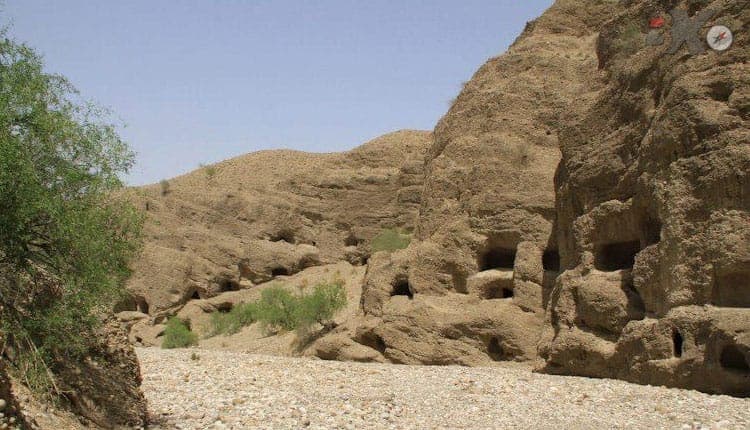
Gondrani, also known by its older name Shehr-e-Roghan, is a cave city cut into sandstone cliffs about 20 km north of Bela in Lasbela District. Historians believe it once housed a Buddhist monastic community, likely around the 8th century, when this part of Balochistan lay within a Buddhist kingdom. An estimated 1,500 chambers once honeycombed the cliffs, roughly 500 survive today, worn down by centuries of erosion and harsh climate.
Why go
- ✦Roughly 500 surviving rock-cut chambers of an original 1,500
- ✦Believed 8th-century Buddhist monastic site
- ✦Sweeping views over the Lasbela plain
- ✦Local legend of the holy woman Mai Gondrani
Shehr-e-Roghan, the Older Name
Gondrani's older name, Shehr-e-Roghan, hints at a settlement whose founders and exact purpose historians still debate. Most place it within a Buddhist kingdom that held sway over this stretch of Balochistan around the 8th century, with the caves serving as cells for meditation and religious practice.
The Caves Themselves
Small, dim chambers are cut directly into the soft sandstone cliffs, some with a veranda-like front room and traces of kitchen space. Erosion and the region's harsh climate have reduced an estimated 1,500 original chambers to roughly 500 still standing today.
Local Legend
Gondrani's everyday name comes from local folklore about Mai Gondrani, a holy woman said to have saved the community from tormenting spirits, a story still told by residents of nearby Bela.
Planning tip
Best Time to Visit, October to March, the site is exposed and shadeless, best avoided at midday in warmer months.
Getting there, About 3.5-4 hours from Karachi via Hub and Bela on the N-25/Winder road, then a short track north of Bela town.
Allow, One to two hours to explore the main cave clusters.
What to Do
Nearby
Straight-line distance from Gondrani Caves (Shehr-e-Roghan), within 5 km.
Nothing else genuinely close by (within 5 km of Gondrani Caves (Shehr-e-Roghan)) is published yet.