
Field guides / Balochistan / Gwadar
Field guide · Coast
Gwadar
A deep-water port city on the Makran coast, framed by the dramatic hammerhead Koh-e-Batil cliffs and twin bays.
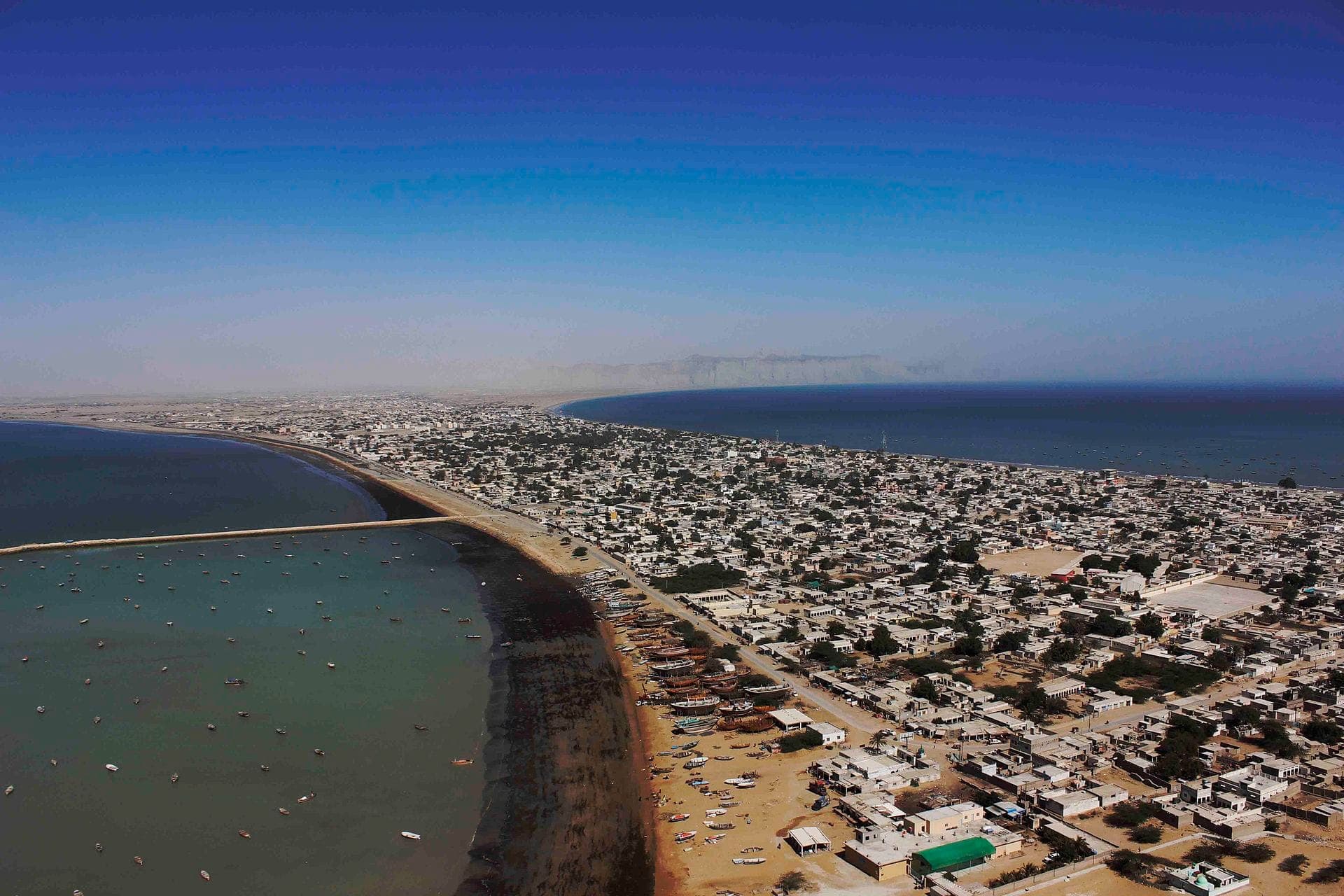
Gwadar is a deep-water port city on the Makran coast of Balochistan, wrapped around a dramatic hammerhead peninsula where two crescent bays meet a flat-topped massif called the Koh-e-Batil. Once a sleepy fishing town, and, until 1958, an overseas possession of the Sultanate of Oman, Gwadar is now the centrepiece of the China-Pakistan Economic Corridor and one of the most strategically watched ports in the Indian Ocean. For the traveller, the draw is the raw coastal geography: the twin bays of the peninsula, the Hammerhead cliffs, long golden beaches, and the surreal mud-volcano and desert landscapes of the surrounding Makran.
Why go
- ✦The Hammerhead peninsula and Koh-e-Batil cliffs
- ✦Twin crescent bays, East Bay and West Bay
- ✦Makran Coastal Highway approach
- ✦Princess of Hope and Hingol within reach
- ✦Omani-era heritage in the old town
The Hammerhead
Gwadar's defining feature is its geography. The town sits on a sandy isthmus that connects the mainland to a broad, flat-topped rocky headland, the Koh-e-Batil, shaped like a hammerhead jutting into the Arabian Sea. Two great curving bays embrace the isthmus on either side, East Bay and West Bay, giving the natural harbour that has made Gwadar coveted for centuries. The clifftop drives along the Batil offer the finest views.
A Port With a History
Gwadar's story is unusually tangled. It was controlled by the Sultanate of Oman from the late 18th century and only became part of Pakistan in 1958, when Pakistan purchased it. In the 21st century it has been transformed by Chinese-led development into a deep-sea port and the maritime gateway of the China-Pakistan Economic Corridor, a project that has put this remote coastal town onto the map of global geopolitics.
Travelling the Makran Coast
Getting to Gwadar is half the experience. The Makran Coastal Highway from Karachi is one of Asia's great coastal drives, past Kund Malir, the Princess of Hope rock formation, Hingol National Park's badlands, and Ormara's tombolo bay. It is also a security-sensitive region: permits or No-Objection Certificates are frequently required and conditions change, so plan through a local operator who handles the paperwork and timing.
Planning tip
Best Time to Visit, November to March, the only comfortable window on this hot, arid coast. Sea breezes moderate the days and nights are mild.
Getting there, Fly from Karachi to Gwadar, or drive the Makran Coastal Highway, a spectacular but long 11-12 hour run from Karachi via Ormara and Kund Malir. Travel in Balochistan requires current security awareness and often a No-Objection Certificate; arrange through an established local operator.
Allow, Two to three days to take in the peninsula, the bays, and a stretch of the Makran coastal drive.
What to Do
Nearby
Straight-line distance from Gwadar, within 5 km.
Nothing else genuinely close by (within 5 km of Gwadar) is published yet.