
Field guides / Sindh / Mohatta Palace
Field guide · Heritage
Mohatta Palace
A pink Rajasthani-stone palace in Karachi's Clifton, now a museum of art and Sindhi heritage.
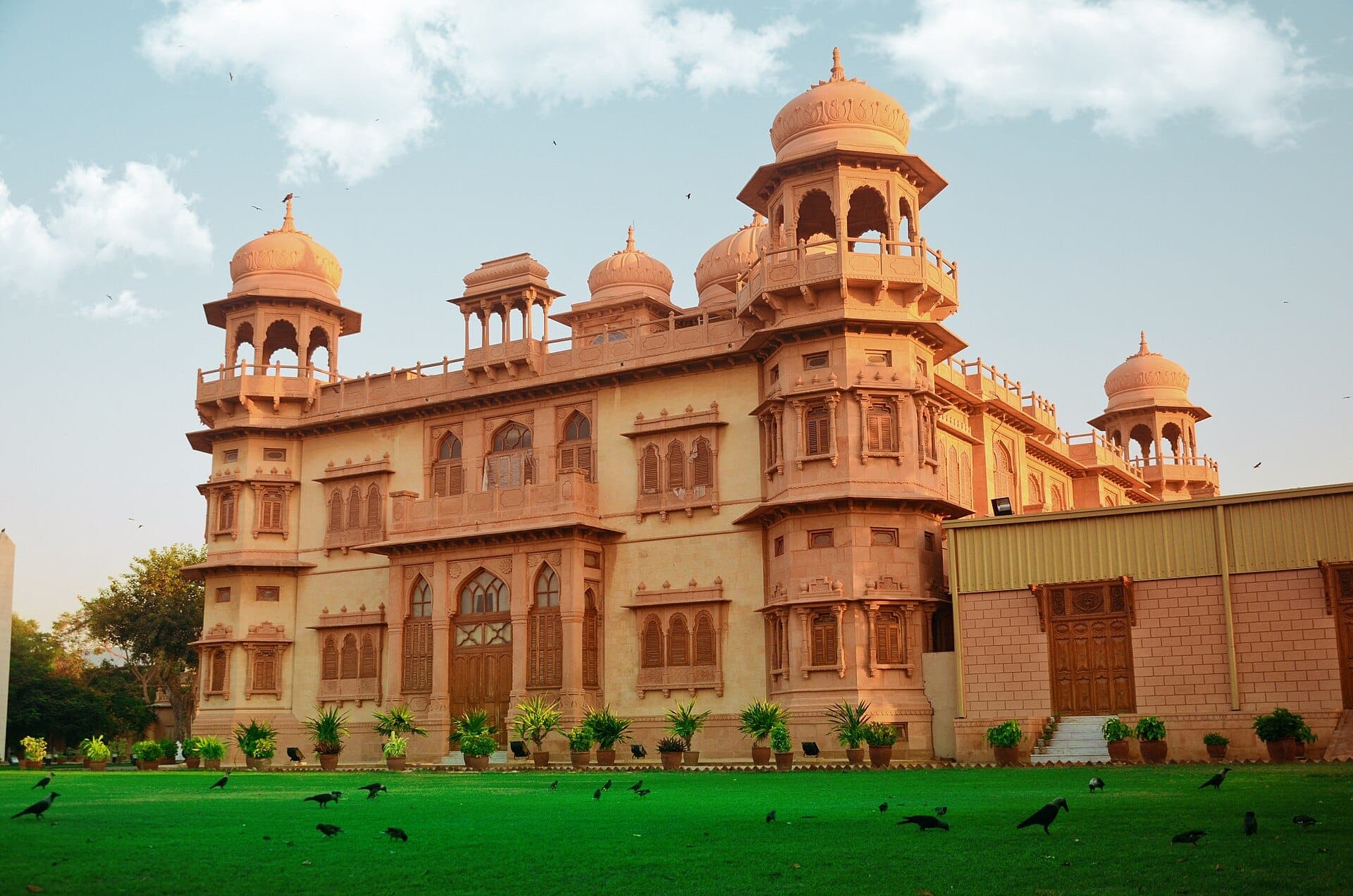
Mohatta Palace is a pink-stone mansion in Karachi's seaside Clifton, built in 1927 as the summer home of Shivratan Mohatta, a Hindu Marwari businessman from what is now Rajasthan, India. Architect Ahmed Hussein Agha, among the first Muslim architects of colonial India, combined pink Jodhpur stone with local yellow Gizri stone to recreate the Anglo-Mughal palace style of Rajasthan's princely houses on the Arabian Sea coast. Mohatta enjoyed the house for barely two decades before Partition sent him to India in 1947; the building later became the Ministry of Foreign Affairs, then in 1964 the home of Fatima Jinnah, sister of the Quaid-e-Azam, who used it as the hub of her presidential campaign against Ayub Khan and gave it the popular name Qasr-e-Fatima. The Government of Sindh acquired it in 1995 and opened it as a museum of Pakistani art and heritage in 1999.
Why go
- ✦Built 1927 for Shivratan Mohatta
- ✦Pink Jodhpur and yellow Gizri stone
- ✦Fatima Jinnah's 'Qasr-e-Fatima', 1964
- ✦Museum of Pakistani art since 1999
- ✦Anglo-Mughal Rajasthani architecture
A Merchant's Summer Palace
Shivratan Mohatta built the house purely as a seasonal retreat, commissioning a design that deliberately echoed the stone palaces of his native Rajasthan even as it sat on Karachi's coastline, carved balconies, domed pavilions, and a symmetrical façade in a combination of pink and yellow stone found nowhere else in the city. Partition cut his time in it short: he left for India in 1947 and never returned.
Qasr-e-Fatima
The palace's most politically charged chapter began in 1964, when Fatima Jinnah moved in and turned it into the operational base for her run against President Ayub Khan, a campaign that, though unsuccessful, cemented her place in the public imagination and gave the house its enduring local nickname, Qasr-e-Fatima, the 'Palace of Fatima.'
A Museum Today
The Sindh government's 1995 purchase and 1999 conversion into a museum saved the building from the fate of many of Karachi's other colonial-era mansions, and it now hosts rotating exhibitions of Pakistani art and heritage across its domed halls and gardens, the architecture itself, carved stone, balconies, and rooftop domes, remains as much the draw as whatever is on the walls.
Plan It with GreenPak
Use Plan a trip to pair Mohatta Palace with Mazar-e-Quaid and Karachi's coastline for a rounded city day.
Planning tip
Best Time to Visit, Year-round, ideally the cooler months. Check current exhibition schedules and opening days before visiting, since the museum's rotating shows sometimes close galleries for changeover.
Getting there, In Clifton, central Karachi, a short drive from the city centre and the seafront, easily combined with Mazar-e-Quaid.
Allow, One to two hours.
What to Do
Nearby
Straight-line distance from Mohatta Palace, within 5 km.