

Field guides / Sindh / Ranikot Fort
Field guide · Heritage
Ranikot Fort
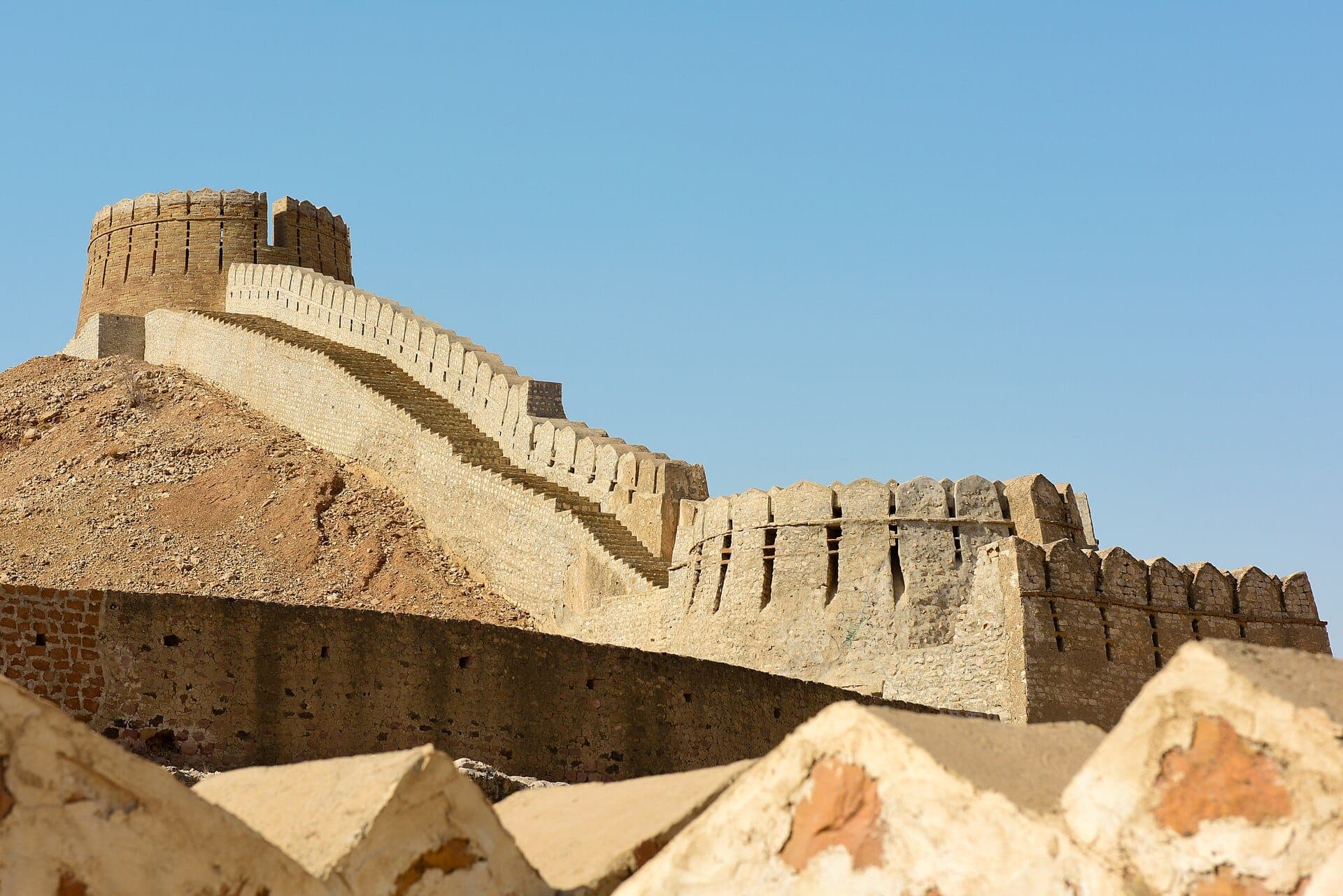
The “Great Wall of Sindh”, a vast historic fort whose ramparts run for some 26 km across the Kirthar foothills.
Ranikot is often called the 'Great Wall of Sindh', among the largest forts in the world, with meandering rubble-stone ramparts running for roughly 32 km around the Kirthar foothills, enclosing streams, low hills, and two smaller inner forts, Miri and Shergarh. Its origins remain genuinely disputed: older theories credited the Sassanians, Scythians, or even the 9th-century Abbasid governor Imran bin Musa Barmaki, but the archaeological consensus now points to construction, or at least major reconstruction, under the Talpur dynasty in the early 19th century, overseen by Nawab Wali Muhammad Leghari at a reported cost of 1.2 million rupees. On Pakistan's UNESCO tentative list since 1993, it is as much a mystery as a monument.
Why go
- ✦Roughly 32 km of ramparts
- ✦Sann and Mohan gates
- ✦Miri and Shergarh inner forts
- ✦Disputed origins, Talpur-era to possibly Abbasid
- ✦Day trip from Karachi
A Fort Without a Clear Story
No inscription or contemporary record definitively settles who built Ranikot or why, which is unusual for a structure of this scale. The walls have been attributed at various points to the Sassanian and Scythian periods, to Bactrian Greek influence, and to the 9th-century Abbasid governorship of Imran bin Musa Barmaki, but current Sindh archaeology holds that the fort as it now stands, or at least its major rebuilding, dates to the Talpur dynasty's rule in 1812, commissioned by the prime minister of Sindh at the time, Nawab Wali Muhammad Leghari.
The Scale on the Ground
The comparison to the Great Wall of China is not just marketing, Ranikot's ramparts climb and drop with the ridgelines for tens of kilometres, punctuated by bastions and gates including the main entrances at Sann and Mohan, with the smaller Miri and Shergarh forts nested inside the perimeter. Walking or driving the rough tracks between them is the only way the scale actually registers; from any single vantage point you see only a fraction of the whole.
Plan It with GreenPak
Carry water and sun cover, there is little shade and few facilities once inside. GreenPak does not yet operate a stay near Ranikot; use Plan a trip to combine it with Karachi's heritage sites and the road toward Thatta and Keenjhar Lake.
Planning tip
Best Time to Visit, November to February. Summer on the Sindh plains is punishingly hot and almost entirely shadeless on the exposed walls.
Getting there, A day trip from Karachi (about 3-4 hours via the Indus Highway near Sann). A 4x4 and a guide help with the rough internal tracks between the gates and the inner forts.
Allow, A full day from Karachi.
What to Do
Nearby
Straight-line distance from Ranikot Fort, within 5 km.
Nothing else genuinely close by (within 5 km of Ranikot Fort) is published yet.