

Field guides / Khyber Pakhtunkhwa / Takht-i-Bahi: UNESCO World Heritage Site
Field guide · Heritage
Takht-i-Bahi: UNESCO World Heritage Site
UNESCO-listed Buddhist monastic complex and one of Gandhara's best-preserved sites.
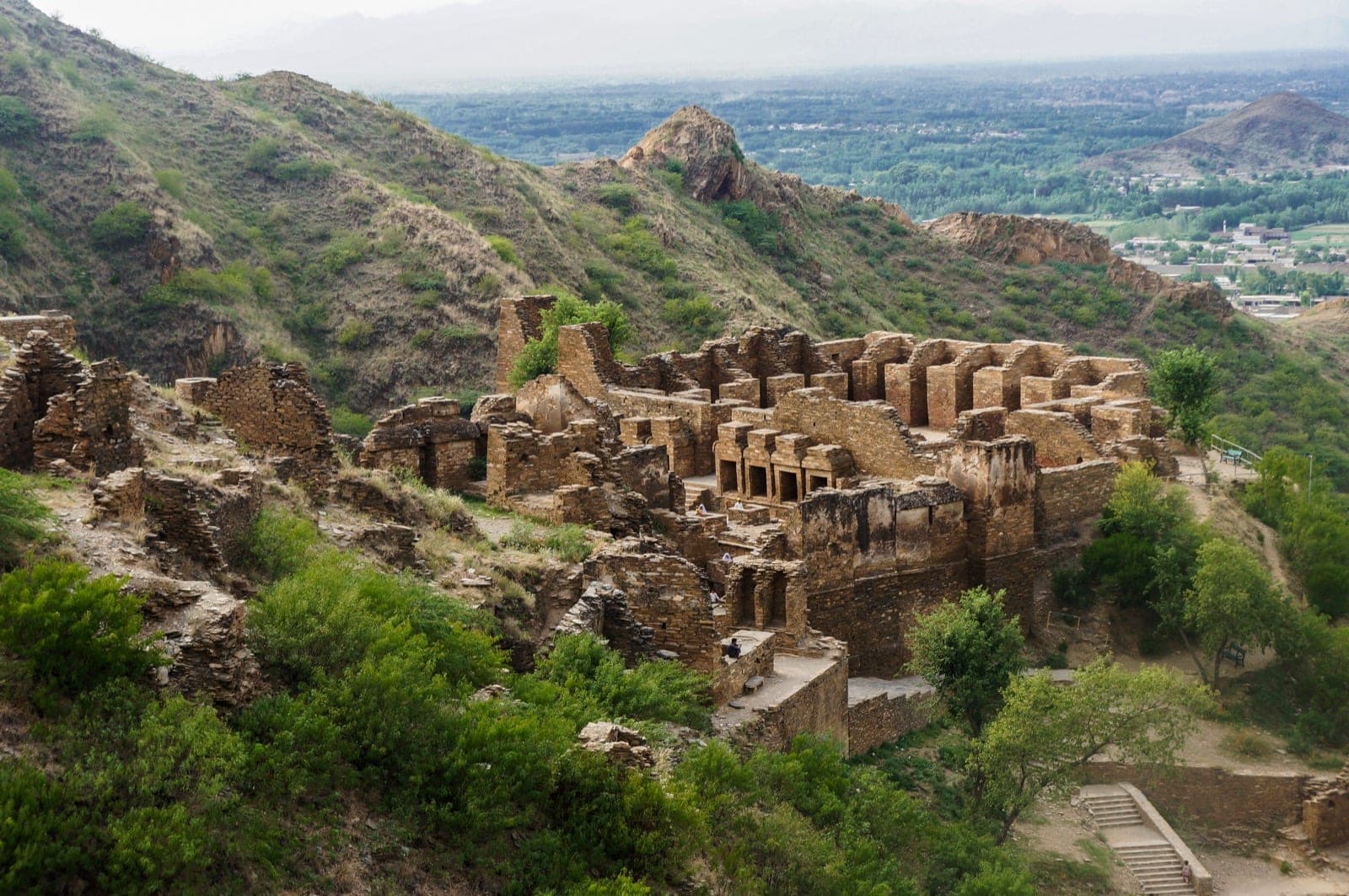
Takht-i-Bahi is the best-preserved Buddhist monastery in Pakistan and a UNESCO World Heritage Site, a 1st-century BCE Gandharan complex spread across a hilltop in Khyber Pakhtunkhwa, near Mardan. Its name means 'spring on the hilltop'. Because it sat high above the plain, out of reach of later flooding and farming, it survived remarkably intact: a court of votive stupas, a monastic quadrangle of meditation cells, assembly halls, and the niches that once held the serene Greco-Buddhist statues now scattered through the world's museums.
Why go
- ✦Best-preserved Gandharan monastery in Pakistan
- ✦Court of votive stupas
- ✦Monastic cells and assembly halls
- ✦Hilltop setting with valley views
- ✦Greco-Buddhist heritage
An Ancient Centre of Monastic Life and Learning
For some seven centuries Takht-i-Bahi was a thriving centre of monastic learning, and its layout still reads clearly: the stupa court where pilgrims circumambulated, the surrounding chapels that held statues of the Buddha, the monks' cells, the kitchen and assembly halls. Its hilltop position kept it safe from the destruction that levelled lower sites.
Sahr-i-Bahlol: The Neighbouring Ancient City
The UNESCO World Heritage property also includes Sahr-i-Bahlol, the remains of an ancient fortified settlement from the Kushan period, located near Takht-i-Bahi.
The Gandhara Connection
Takht-i-Bahi belongs to the Gandhara civilisation, where Buddhist devotion met Greco-Roman artistic style to produce the first human images of the Buddha, figures with classical drapery and faces. The sculptures that once filled these niches are now in museums in Peshawar, Lahore, and abroad; seeing the empty niches in situ and the carvings in a museum together completes the picture.
Visiting the Site
It is an open archaeological site reached by a short but real uphill walk, so wear decent shoes and bring water and sun protection. A guide helps decode which courtyard did what. The views over the surrounding fields from the monastery terraces are part of why the monks chose this spot.
Planning tip
Best Time to Visit, October to March offers the most comfortable weather for exploring the hilltop complex. During warmer months, visitors should plan an early-morning visit and carry drinking water.
Getting there, About 15 km from Mardan, roughly a two-hour drive from Islamabad and a 1.5-hour drive from Peshawar. From the car park a short uphill walk leads to the ruins; the climb rewards with valley views.
Allow, Two to three hours on site; combine with Mardan or the wider Gandhara circuit.
What to Do
Nearby
Straight-line distance from Takht-i-Bahi: UNESCO World Heritage Site, within 5 km.
Nothing else genuinely close by (within 5 km of Takht-i-Bahi: UNESCO World Heritage Site) is published yet.