

Field guides / Punjab / Amb Temples
Field guide · Heritage
Amb Temples
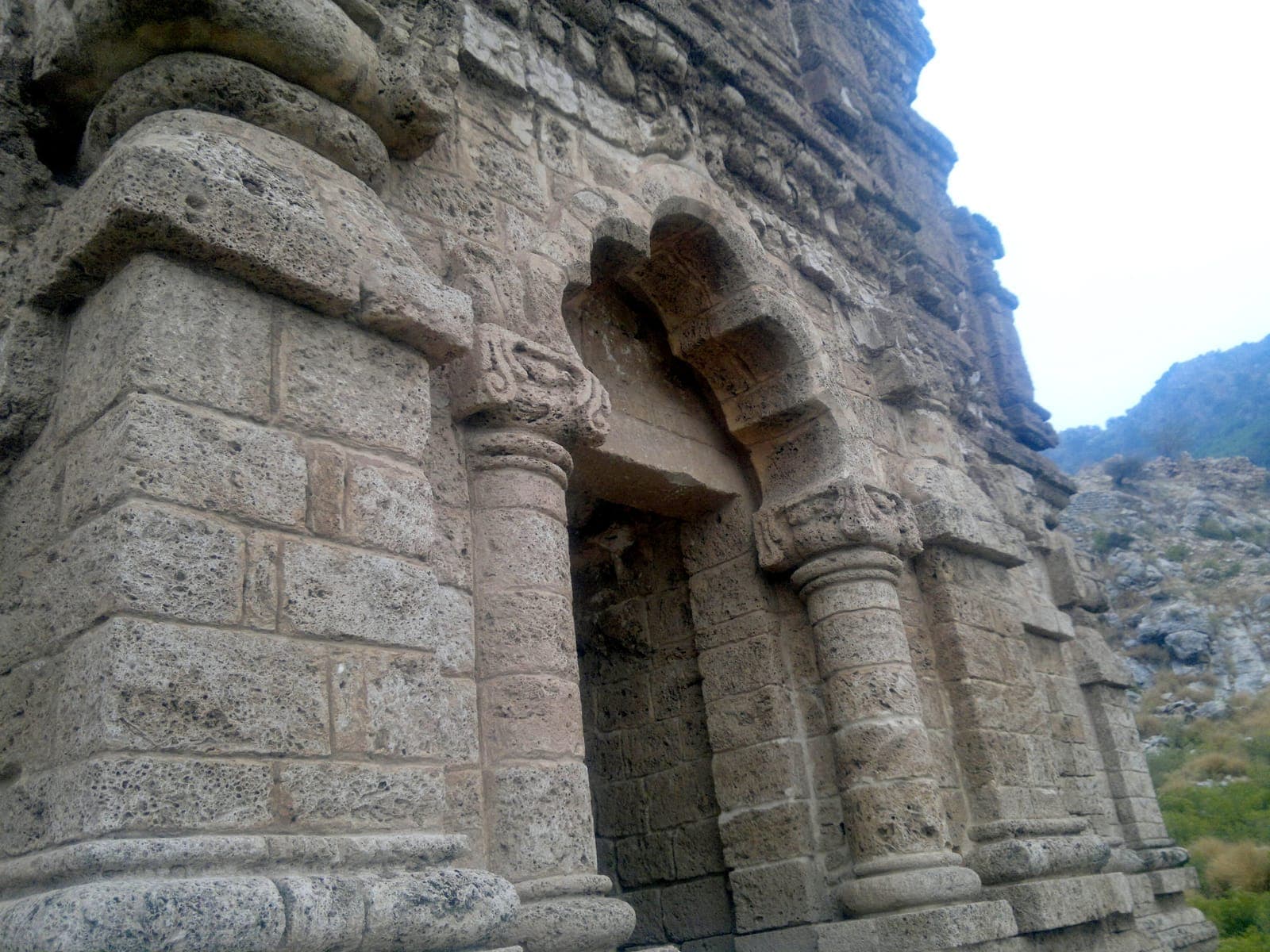
The Amb Temples in the Salt Range near Sakesar: a 9th–10th-century Hindu temple complex of the Hindu Shahis, its main temple some 15 m tall.
The Amb Temples stand on the western edge of the Salt Range near Amb Sharif village, below Sakesar peak in the Soon Valley. Inside the ruins of a fort, a large temple and a smaller one survive, built of kanjur, a porous local stone, in the Gandhara Nagara style. The main temple rises about 15 metres on a square plinth, three storeys high, with stairs leading to inner ambulatories and Kashmiri-style motifs, including a cusped niche, on its outer walls.
Why go
- ✦A Hindu Shahi temple complex of the 9th–10th century
- ✦Main temple about 15 m tall, three storeys
- ✦Kashmiri-style carved niches
- ✦Protected under the Antiquities Act 1975
History
The complex was built in the 9th to 10th centuries CE by the Hindu Shahi (Odi Shahi) dynasty; the fort around it goes back to the late Kushan period. The main temple is counted the loftiest the dynasty built, and is the westernmost of the string of Salt Range temples that includes Katas Raj and Tilla Jogian. Alexander Cunningham visited in the late 19th century, the last statues were taken to the Lahore Museum, and Daya Ram Sahni partly conserved the site in 1922–24. A second small temple has since disappeared.
How to Reach
Near Amb Sharif village in the Soon Valley, Khushab District, below Sakesar; the last stretch is a rough track, so use the map on this page and ask locally.
Planning tip
Best Time to Visit, October to April; the Salt Range is hot in summer.
Getting there, Near Amb Sharif village in the Soon Valley, Khushab District, below Sakesar; the last stretch is a rough track, so use the map on this page and ask locally.
Allow, About an hour.
What to Do
Nearby
Straight-line distance from Amb Temples, within 5 km.
Nothing else genuinely close by (within 5 km of Amb Temples) is published yet.