
Field guides / Balochistan / Ancestral Graveyard of Jam of Lasbela
Field guide · Heritage
Ancestral Graveyard of Jam of Lasbela
The ancestral graveyard of Jam of Lasbela, the Chief Minister of Baluchistan is situated about 6.5 km to the North of Bela Town.
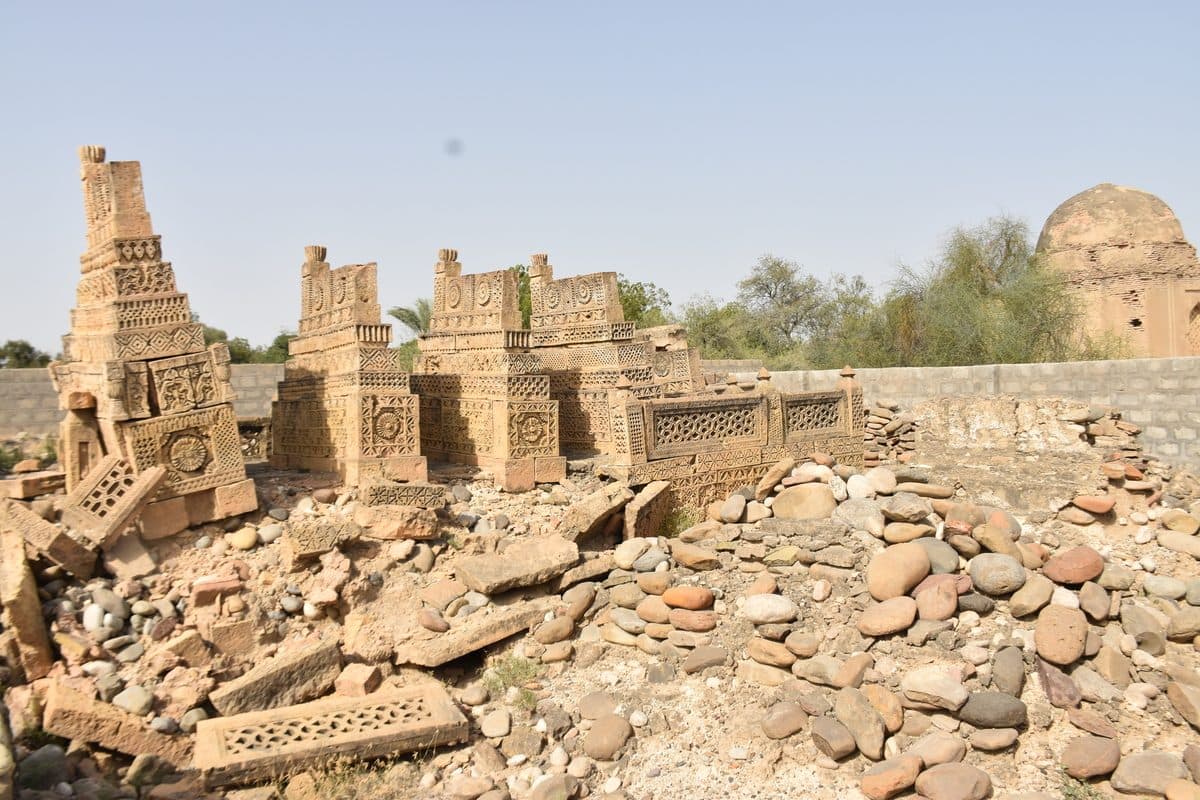
The place is locally known as Tharle (Large Garden). It is spread over an area of about 4000 sq. m. The graveyard contains a tomb constructed with burnt bricks, a group of four graves in paramedical form and a pillared canopy constructed in buff sand stone in Chaukhadi type, a group of two lime plastered graves and in a separate enclosed wall, the graves of the forefathers of Jam of Lasbela. Close study of this graveyard reveals that it is similar to Chaukhandi type graveyard and also similar to those which are found in other areas of Sind and Baluchistan and are generally dated to the 17th/18th centuries CE the details of the tomb and the other Chaukhandi type graves are enumerated below: -1: Unknown tomb in burnt bricks, 2: Chaukhandi type graves, 3: Graves under a Pillared Canopy, 4: Lime plastered graves, 5: Graves constructed within the enclosed wall.
Why go
- ✦Known locally as Tharle — the large garden
- ✦Five distinct grave groups across about 4,000 square metres
- ✦A pillared canopy in buff sandstone, Chaukhandi in type
- ✦The Jam's forefathers set apart behind their own wall
- ✦Of a piece with Chaukhandi burial across Sindh and Balochistan
History
The Jams were the hereditary rulers of Lasbela, a princely state on the Balochistan coast. Their graveyard belongs to the Chaukhandi tradition of carved sandstone funerary architecture that runs along the coast from Karachi into Balochistan, built between roughly the fifteenth and eighteenth centuries by the Jokhio, Jam and Baloch tribes. Here the five groups include a burnt-brick tomb, a set of four graves, a pillared canopy of buff sandstone in the Chaukhandi manner, two lime-plastered graves, and the walled enclosure of the ruling line.
Historical Significance
The dynastic burial ground of a ruling house, built in a regional tradition that is otherwise mostly tribal — which is why the styles sit side by side here.
Architecture
The whole is closely related to the Chaukhandi graveyards found elsewhere in Sindh and Balochistan, generally dated to the seventeenth and eighteenth centuries.
Why Visit
Five burial styles in one enclosure, with the pillared sandstone canopy the finest thing in it.
Interesting Facts
- It is known locally as Tharle, meaning the large garden
- Five distinct grave types stand within one 4,000-square-metre enclosure
- The ruling family's own graves are walled off from the rest
Planning tip
Best Time to Visit, November to March.
Getting there, Lasbela district in southern Balochistan. The Jam's graveyard is about 6.5 km north of Bela town; the Hinidan graves lie on the right bank of the Hab river, approached by unmetalled but motorable road through hill torrents — the river crossing is still unbridged.
Allow, An hour to ninety minutes at each.
What to Do
Make Ancestral Graveyard of Jam of Lasbela Part of a Trip
GreenPak resorts within reach, and the journeys that travel this region.

Nearby
Straight-line distance from Ancestral Graveyard of Jam of Lasbela, within 30 km.