
Field guides / Sindh / Lakhian Jo Daro
Field guide · Heritage
Lakhian Jo Daro
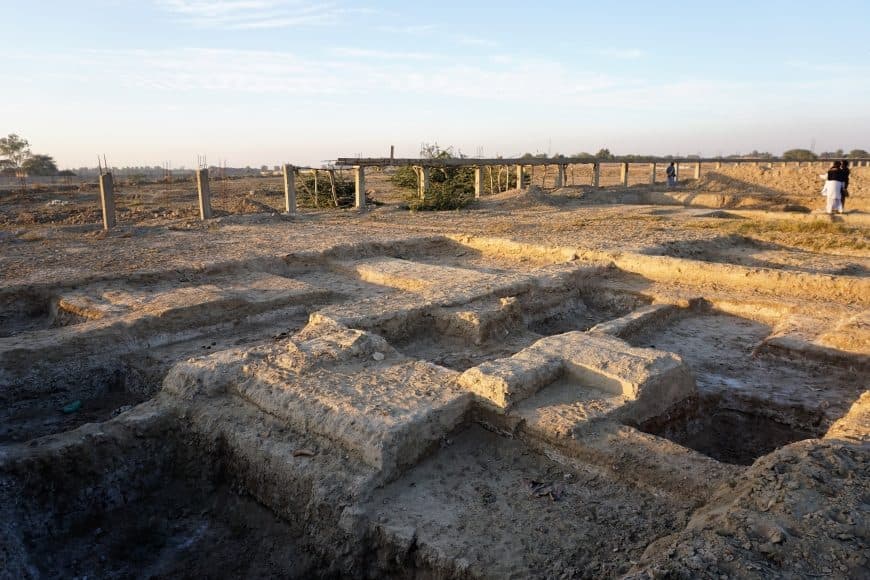
A settlement site contains remains of Bronze Age.
A settlement site contains remains of Bronze Age.
Why go
- ✦A Bronze Age settlement mound
- ✦Occupied within the 3500–1800 BCE range
- ✦Part of the wider Indus-era landscape of upper Sindh
History
The site was identified in 1985 by Professor Qasid Mallah and his team from Khairpur, and excavated from the 1990s onward by archaeologists from the University of Sindh and Shah Abdul Latif University. What has come out of the ground marks it as a major Bronze Age settlement deeply engaged in craft production: semi-precious stones, beads, shell and stone bangles, seals, weights, covered drains and brick platforms.
Historical Significance
On area alone, Lakhian jo Daro ranks as one of the two or three largest Indus cities known — a discovery that reshapes the map of the civilisation in Upper Sindh. It is also among the least protected: the site lies inside an industrial zone and has suffered badly from encroachment.
Architecture
A settlement site in Sukkur district holding remains of the Bronze Age, within the 3500–1800 BCE horizon of the Indus world.
Why Visit
A city the size of Mohenjo-daro that almost nobody has heard of, still largely unexcavated, on the edge of a working industrial estate.
Interesting Facts
- At over 300 hectares it is larger in area than Mohenjo-daro
- It was only identified in 1985 — recent, for a city of this scale
- Finds point to intensive craft production: beads, shell bangles, seals and standardised weights
- The site sits inside an industrial zone, and much of it has been damaged
Planning tip
Best Time to Visit, November to February. Upper Sindh summers are extreme.
Getting there, Sukkur is on the N-5 and the main railway line, about 470 km north of Karachi. Bakhar island and Rohri sit together on the Indus at the city's edge.
Allow, Two to three hours for the riverside monuments; a half day for Sukkur as a whole.
What to Do
Make Lakhian Jo Daro Part of a Trip
GreenPak resorts within reach, and the journeys that travel this region.
Nearby
Straight-line distance from Lakhian Jo Daro, within 30 km.