
Field guides / Punjab / Tope or Stupa (Mankiyala)
Field guide · Heritage
Tope or Stupa (Mankiyala)
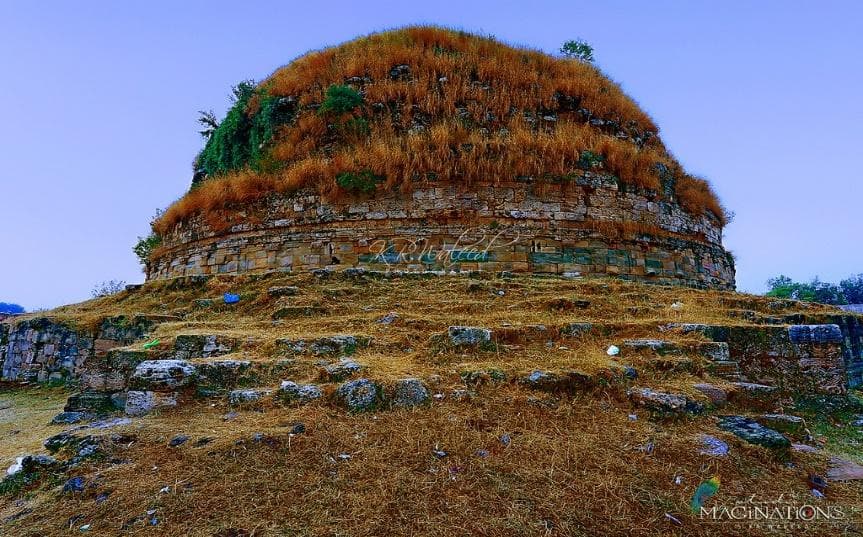
An archaeological site comprising of a stupa standing prominently and visible from a long distance due to its large circumstance and conspicuous height which measures about 6.4 m.
The Mankiala stupa marks the spot where, according to the Jataka tales, a previous incarnation of the Buddha — Prince Sattva — offered his own body to feed a starving tigress and her seven cubs. It is the most conspicuous Buddhist monument in northern Punjab, standing beside the Grand Trunk Road about 36 km south-east of Islamabad.
Why go
- ✦Visible from a long way off across the Potohar plain
- ✦A large-circumference stupa of the 1st to 5th centuries CE
- ✦Stands directly beside the Grand Trunk Road
- ✦One of the most conspicuous Buddhist monuments in northern Punjab
History
The stupa is generally attributed to the reign of the Kushan emperor Kanishka, between 128 and 151 CE; an alternative tradition counts it among the eighty-four stupas said to have been raised by Ashoka to house the Buddha's ashes. In 1830 General Ventura, a French officer in Ranjit Singh's army, sank a shaft more than 22 metres deep into its centre. Three metres down he found an iron box holding a smaller gold box; deeper still, between 13.7 and 19.5 metres, a second deposit of gold and copper objects with Sassanian and Kushan coins.
Historical Significance
One of the earliest scientifically recorded excavations in the subcontinent, and a key find for dating Kushan Buddhism. The relics were removed during the British period and are now in the British Museum.
Architecture
It belongs to the first to fifth centuries CE, when Buddhist foundations spread across the Potohar plateau between Taxila and the Salt Range.
Why Visit
A story of self-sacrifice from the Jataka tales, marked by a stupa you can see from the motorway, whose contents are now in London.
Interesting Facts
- It marks where the Buddha, in a previous life, is said to have fed himself to a starving tigress and her cubs
- General Ventura, a Frenchman in Ranjit Singh's army, dug 22 metres into it in 1830
- He found an iron box containing a gold box, with coins of Kushan and Sassanian rulers
- The relics he recovered are now held by the British Museum
Planning tip
Best Time to Visit, October to April; spring is the pick. Summer on the Potohar plateau is hot and hazy.
Getting there, Along the Grand Trunk Road south-east and west of Rawalpindi. Bhallar and the Wah gardens sit within reach of the Taxila museum and its excavated cities; Mankiyala lies on the GT Road towards Jhelum.
Allow, An hour at each; a full day for Taxila and its outlying stupas.
What to Do
Make Tope or Stupa (Mankiyala) Part of a Trip
GreenPak resorts within reach, and the journeys that travel this region.
Nearby
Straight-line distance from Tope or Stupa (Mankiyala), within 30 km.