
Field guides / Punjab / Dai Anga's Mosque
Field guide · Heritage
Dai Anga's Mosque
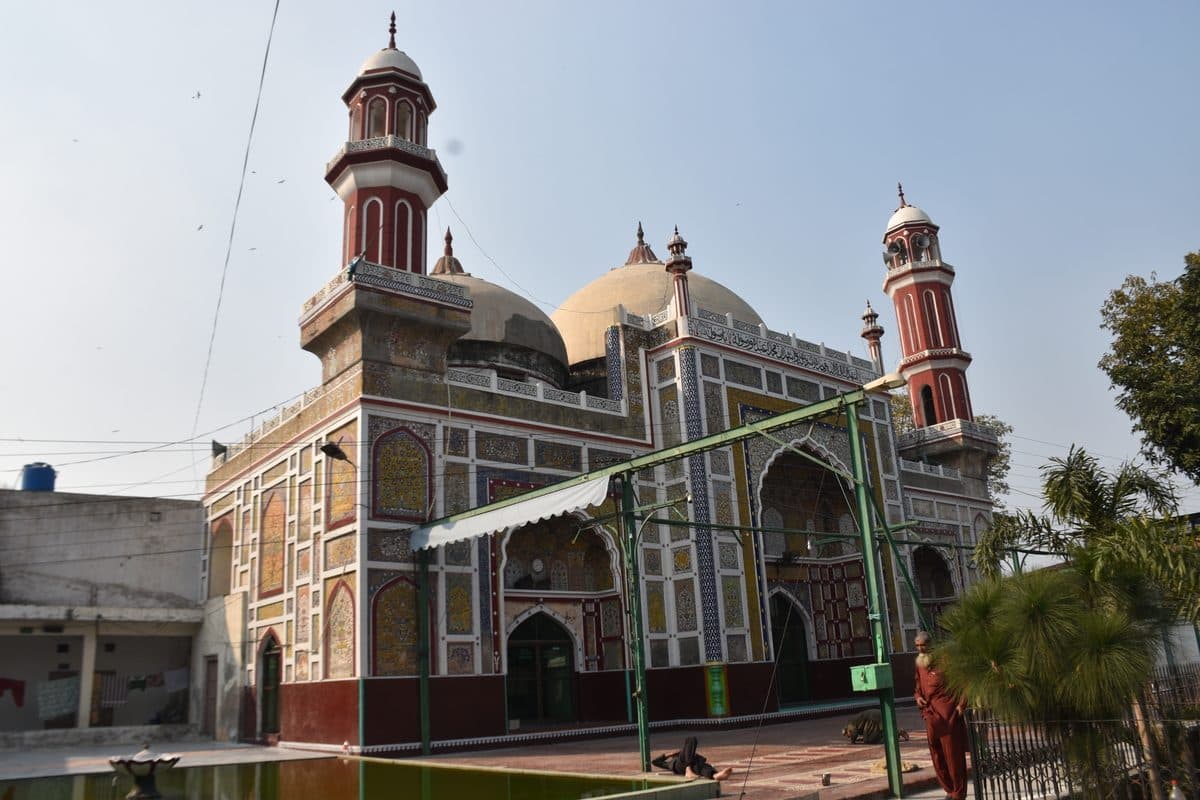
A mosque situated near the Railway station of Lahore and notable for its minute and refined enameled tile, mosaic work.
It is the only surviving monument of a decent quarter of Mughal period Lahore called Mohalla Dai Anga, a locality of rich men and nobles of the city. Ranjit Singh used the mosque as a military magazine. Later on, it was turned into the private residence of Mr. Henry Cope and editor of the old Lahore Chronicle newspaper and press.
Why go
- ✦Minute, refined enamelled tile and mosaic work
- ✦The only surviving monument of Mohalla Dai Anga
- ✦Built for the wet-nurse of Emperor Shah Jahan
- ✦Used as a Sikh military magazine, then as a newspaper editor's house
History
Her husband Murad Khan served Jahangir as Magistrate of Bikaner, and their son Muhammad Rashid Khan was among the finest archers in the empire, dying in the service of Shah Jahan's eldest son Dara Shikoh. The mosque stands south-east of Lahore railway station in the Naulakha quarter, its frescoes, calligraphy and tile mosaic worked in the palette typical of Shah Jahan's reign. Her own tomb is elsewhere in Lahore, in the Gulabi Bagh — a pleasure garden converted to hold her grave in 1671. In later centuries Ranjit Singh used the mosque as a military magazine, and it afterwards became the private residence of Henry Cope, editor of the old Lahore Chronicle.
Historical Significance
A rare major Mughal foundation by a woman who was neither royal nor noble by birth, and one of the finest small tile buildings of Shah Jahan's Lahore.
Why Visit
For the tilework, and for a building commissioned by a servant of the imperial household that has outlasted most of the nobles' mosques around it.
Interesting Facts
- Dai Anga's real name was Zeb-un-Nisa; 'Dai Anga' was her role — wet-nurse to Shah Jahan
- She began the mosque in 1635, just before departing for the Hajj
- Her son was one of the empire's best archers and died serving Dara Shikoh
- Ranjit Singh stored gunpowder here; a British newspaper editor later lived in it
Planning tip
Best Time to Visit, October to March. Lahore's summer is fierce and the Walled City offers little shade; December and January can be heavily smog-bound.
Getting there, All within Lahore. The Walled City monuments — the gates, Mariam Zamani, Wazir Khan's Baradari and Hammam — sit close enough to walk between; Shahdara, Baghbanpura and Mughalpura are a short drive out.
Allow, Thirty minutes to an hour at each; a full day for the Walled City circuit.
What to Do
Make Dai Anga's Mosque Part of a Trip
GreenPak resorts within reach, and the journeys that travel this region.
Nearby
Straight-line distance from Dai Anga's Mosque, within 30 km.