
Loading…
Field guides / Gilgit-Baltistan / Shatial Rock Carving
Field guide · Heritage
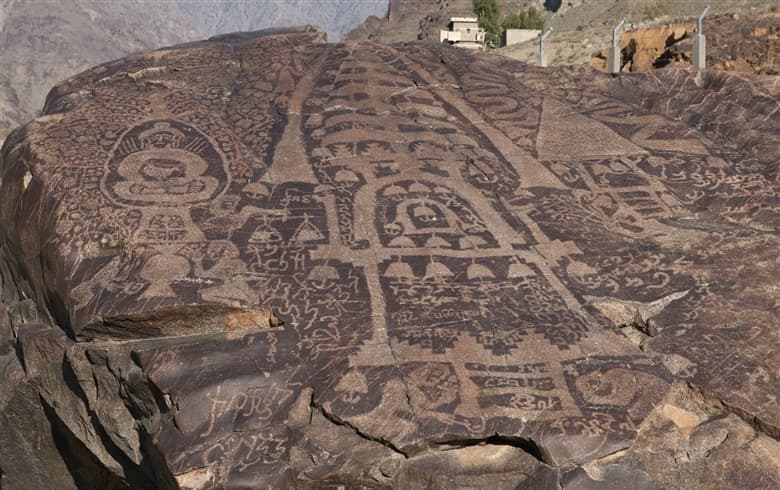
Shatial is an important archaeological site located in the Gilgit-Baltistan region of northern Pakistan, along the Karakoram Highway.
It is situated 60 kilometers west of Chilas, beside the Indus River. Historically, Shatial served as a significant transit point connecting several regions, including Swat Valley, Gilgit, Chilas, and Chitral. The site is renowned for its numerous inscriptions and petroglyphs, which were left by traders, Buddhist missionaries, and travelers passing through the area. More than 1,000 inscriptions and 700 petroglyphs are found at Shatial, with many dating back to the third to seventh centuries. These include inscriptions in the Sogdian language, Bactrian, Middle Persian, and Parthian, as well as in ancient Brahmi and Kharosthi scripts, indicating that the site was a Buddhist shrine. Among the inscriptions is a detailed message by Nanai- vandak, an Iranian merchant, providing insight into the cultural and religious practices of the time. The presence of Buddhist imagery, including a large triptych of a stupa and the Sibi Jataka, further underscores Shatial’s significance as a historical and religious crossroads on the Silk Road.
Why go
The Shatial Rock Carvings in Gilgit-Baltistan face imminent submersion from the Dasu Dam, with no active protection under the Gilgit-Baltistan Archaeology Department. Despite their UNESCO-noted significance, no emergency documentation or relocation efforts are underway. Urgent federal-provincial intervention is needed to preserve this endangered heritage site before it's lost. Located at Karakoram Highway, Gilgit-Baltistan
Planning tip
Best Time to Visit, Year-round; confirm local conditions and any festival dates before travel.
Getting there, In or near West of Chilas, Gilgit-Baltistan; confirm current local access before visiting.
Straight-line distance from Shatial Rock Carving, within 30 km.
Nothing else genuinely close by (within 30 km of Shatial Rock Carving) is published yet.