
Field guides / Sindh / Gori Temple
Field guide · Heritage
Gori Temple
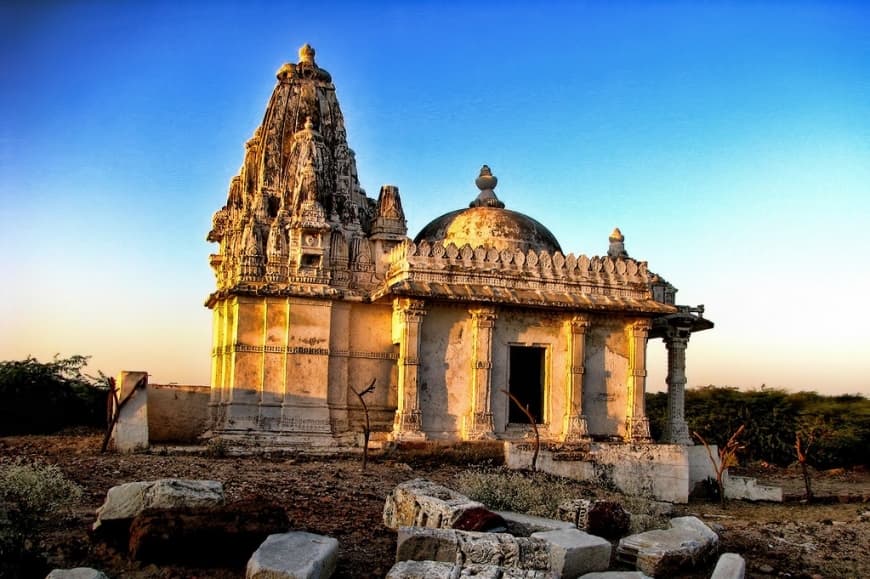
The temple is situated 23 km north-west of Virawah and closely resembles the temples at Bodhesar.
The effects of fire and gun power used by Col. Tyrwhitt are still quite marked but still one of the best-preserved surviving temples. It is built of local stone with pillars and details of marble from Rajputana. It consists of three parts i.e., an outer stone Mandapa or pavilion with marble pillars and corbelled dome leading to an interior Mandapa of similar design by supplemented by small cells. The shrine itself which formerly had a shikara of typical Kathiwar style, but now adorned with rows of miniature shikaras. The temple according to an inscription was repaired in 1715 CE.
Why go
- ✦One of the best-preserved temples surviving in Tharparkar
- ✦Local stone with pillars and detail in Rajputana marble
- ✦Two mandapas leading to the shrine, under corbelled domes
- ✦Rows of miniature shikharas where a single Kathiawar shikhara once stood
- ✦Repaired in 1715 according to its own inscription
History
The temple was raised during the ascendancy of the Sodha Rajputs in the Parkar country, in a Gujarati style, on a high platform — roughly 125 by 60 feet, built of white marble, with three mandapas and fifty-two domes. The domed ceiling of the canopy carries paintings of Parshvanatha being welcomed by yakshas and yakshinis, along with images of the Tirthankaras Neminatha and Mahavira. The building was later damaged by fire and gunpowder during a colonial military action under Colonel Tyrwhitt, and an inscription records a repair in 1715.
Historical Significance
The frescoes are the oldest Jain wall paintings surviving in the northern subcontinent. In 2016 the temple and its neighbours were placed on Pakistan's UNESCO World Heritage tentative list as the Nagarparkar Cultural Landscape.
Architecture
The temple stands 23 km north-west of Virawah and closely resembles those at Bhodesar. The marks of fire and gunpowder used by Colonel Tyrwhitt are still plain on it, yet it remains one of the best-preserved temples surviving in the region. It is built of local stone with pillars and detailing in marble brought from Rajputana, and falls into three parts: an outer stone mandapa with marble pillars under a corbelled dome, an inner mandapa of similar design supplemented by small cells, and the shrine itself, which once carried a shikhara of the typical Kathiawar type and is now crowned instead with rows of miniature shikharas.
Why Visit
A white marble Jain temple under fifty-two domes in the Thar desert, holding paintings that exist nowhere else.
Interesting Facts
- The ceiling frescoes are the oldest surviving Jain paintings in the northern subcontinent
- Fifty-two domes stand over a building of white marble, roughly 125 by 60 feet
- It is dedicated to Parshvanatha, the twenty-third Tirthankara
- On the UNESCO tentative list since 2016 as part of the Nagarparkar Cultural Landscape
Planning tip
Best Time to Visit, November to February. After good monsoon rain the desert briefly turns green, which is the most striking time to see it.
Getting there, Nagarparkar lies at the far south-east of Sindh, roughly 450 km from Karachi via Mirpurkhas. The Bhodesar and Gori temples are within a short drive of the town.
Allow, A full day around Nagarparkar; the distance makes an overnight stay sensible.
What to Do
Make Gori Temple Part of a Trip
GreenPak resorts within reach, and the journeys that travel this region.
Nearby
Straight-line distance from Gori Temple, within 30 km.